Dr. Salvador Esquena explains on TV3 why frequent ejaculation improves sperm quality
The director of UROCAT participates in “Tot es mou” on TV3 to talk about new studies on male fertility and prostate cancer screening.
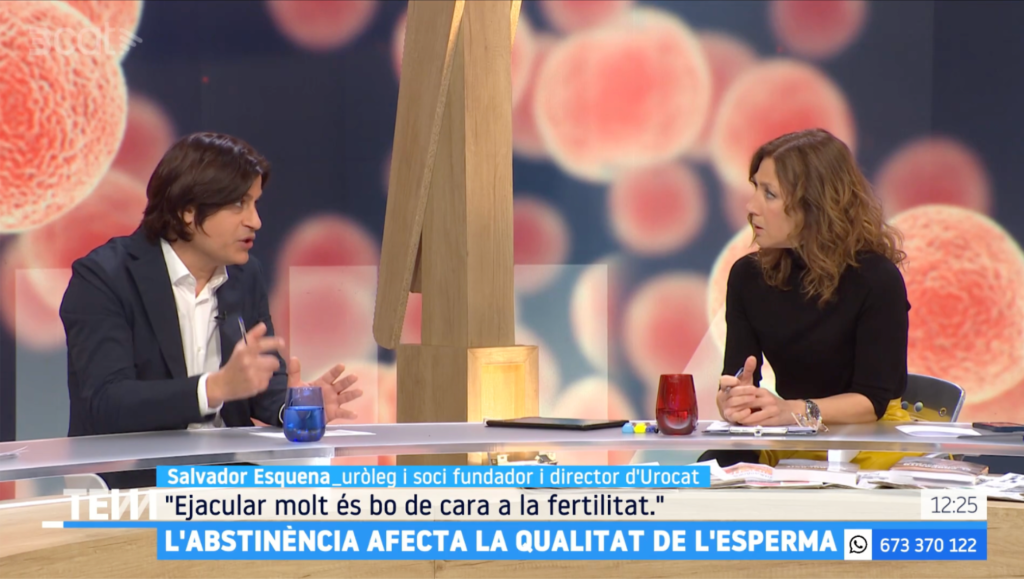
The director of UROCAT, Dr. Salvador Esquena, intervened as a reference expert in the TV3 program “Tot es mou” to talk about two news items that have generated great interest in the field of urology and reproductive medicine: the relationship between ejaculation frequency and sperm quality, and the new European recommendations on prostate cancer screening.
Frequent ejaculation improves sperm quality: evidence from a meta-analysis of more than 170 studies
One of the questions Dr. Esquena addressed in front of the cameras was one that many couples undergoing fertility treatments have asked themselves at some point: How many days of abstinence should be done before in vitro fertilization? Until now, WHO recommendations pointed to seven days. But a recent meta-analysis, a systematic analysis of the existing scientific literature that brings together more than 170 studies in humans and animals, has brought to the table a conclusion that contradicts this classic guideline.
“The less time that sperm has been waiting for, the better it is for fertilization, both natural and in vitro“, pointed out by Dr. Salvador Esquena.
Stored sperm deteriorate rapidly. The cells lose quality in three fundamental parameters that andrologists analyze in a semen analysis: volume (number of sperm), motility and morphology (the shape of the sperm).
A semen high in volume but with deteriorated genetic material has a lower fertilizing capacity than a more modest but better quality sample.
Given this evidence, Dr. Esquena pointed out that many fertility specialists had already reduced the recommended abstinence period to three to five days, and that the new trend points to periods of two to four days at most.
“The WHO sometimes is a little bit at odds with clinical practice. We, the specialists who see patients day-to-day, are a little more up to date”, explained Dr. Salvador Esquena.
As to whether frequent ejaculation is beneficial for prostate health in general, Dr. Esquena was precise: there is no study that has shown that it reduces the risk of prostate cancer from an organic point of view, although from an emotional point of view, even in masturbation, it is a recommendable practice.
New European criteria for prostate cancer screening: digital rectal examination no longer required for all patients
The second major news item was the update of the European guidelines on the early detection of prostate cancer, the most common cancer in men.
Dr. Esquena recalled the importance of periodic screening: when diagnosed in time, almost one hundred percent of cases are cured. That is why it is so important for men to go, since prostate cancer is asymptomatic.
Screening recommendation: From 45-50 years of age (or from 40 with family history or risk groups).
The most outstanding update, announced at the last European urology congress, is that digital rectal examination has disappeared from the screening recommendations, replaced by more precise and less invasive diagnostic tools: PSA (prostate-specific antigen) blood test and, if necessary, an MRI or other specific tests.
“We hope that this will make some men lose their fear of visiting the urologist. Many avoided coming precisely because of the fear of the rectal exam”, Dr. Salvador Esquena assured.
The doctor reminded that PSA is not usually automatically included in a routine blood test: it is necessary to expressly ask the family doctor for it.
UROCAT, a reference in urology in Barcelona and a trusted source for the media
The participation of Dr. Salvador Esquena on TV3 confirms the role of UROCAT as a clinical and informative reference in urology in Barcelona. Our commitment to communication based on scientific evidence and a personal approach to patients is the basis of a care model that we put into practice every day in the office.
If you have any questions about male fertility, sperm quality or want to have a prostate examination, our team of specialists is at your disposal.