
Urinary Lithiasis (Kidney or Urinary Tract Stones)
Urinary lithiasis, also known as urolithiasis, refers to the formation of calculi or stones in the urinary system, which includes the kidneys, ureters, bladder, and urethra.
These calculi are solid masses that develop from crystals present in the urine. They can vary in size, from tiny like grains of sand to large enough to occupy the entire renal cavity. Stone formation is a common condition that affects approximately 5% to 10% of the population at some point in their lives. There is a significant hereditary component.
Symptoms
The symptoms of urinary lithiasis can vary depending on the location and size of the stone. Some stones may cause no symptoms and be discovered incidentally, but when they do appear, the most common symptoms include:
- Severe pain (renal colic): sharp, intense pain in the back or side that may radiate to the lower abdomen and groin.
- Hematuria: presence of blood in the urine, which may appear pink, red, or brown.
- Nausea and vomiting: often accompanying severe pain.
- Frequent urination: constant urge to urinate, even when only small amounts are passed.
- Fever and chills if there are a concurrent infection.
It is important to note that symptom severity does not always correlate with stone size; even small stones can cause severe pain if they obstruct urinary flow.
Diagnosis
The diagnosis of urinary lithiasis involves a combination of clinical evaluation, laboratory tests, and imaging studies:
- Medical history and physical examination: assessment of symptoms, history of stones, and risk factors.
- Urinalysis: to detect blood, crystals, infections, or abnormalities in urine composition.
- Blood tests: to evaluate kidney function and detect metabolic imbalances that may contribute to stone formation.
- Imaging (radiology): ultrasound is commonly used to visualize stones in the urinary tract. X-rays of the urinary tract can also help locate stones. However, non-contrast computed tomography (CT) is the test that provides the most detailed images and is the most effective in identifying stones and their precise location. The choice of imaging depends on the clinical situation and equipment availability.
Treatment
Management of urinary lithiasis depends on the size, location, and composition of the stones, as well as the presence of symptoms or complications:
- Conservative management: for small, uncomplicated stones, close observation may be chosen, encouraging high fluid intake to promote spontaneous passage of the stone. Medical expulsive therapy may include medications to relax ureteral muscles and facilitate stone passage.
- Extracorporeal shock wave lithotripsy (ESWL): a non-invasive procedure that uses shock waves to break stones into smaller fragments that can be passed in the urine. It is suitable for most patients, but success depends on stone size and location.

Source: European Association of Urology
- Ureteroscopy: an endoscopic procedure where a ureteroscope is inserted through the urethra and bladder into the ureter or kidney to visualize and treat stones. Stones may be directly removed or fragmented using a laser or other tools. This is an option for stones unsuitable for ESWL or that have not passed spontaneously.
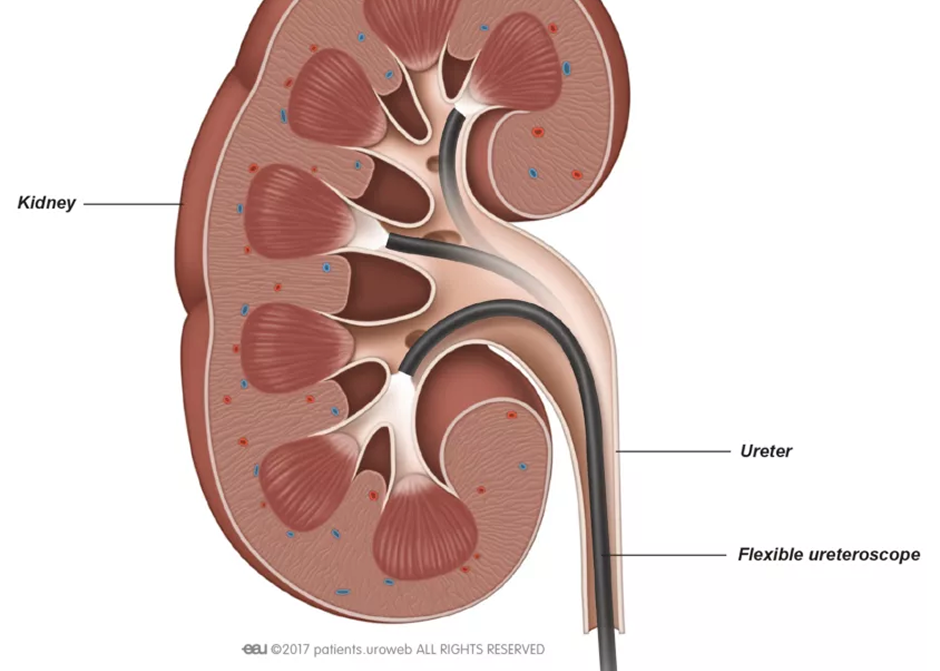
Source: European Association of Urology
- Percutaneous nephrolithotomy (PCNL): a minimally invasive surgical procedure involving a small incision in the skin to access the kidney directly and remove large or complex stones. It is considered when other modalities are not effective or appropriate.
Source: European Association of Urology
Treatment choice should be individualized, taking into account the stone’s specific characteristics and the patient’s circumstances.
Prevention
After treatment of a stone, it is important to implement measures to prevent the formation of new stones:
- Adequate hydration: drinking 2.5 to 3 liters of fluids daily to dilute urine and reduce the concentration of stone-forming substances.
- Balanced diet: consuming a diet rich in fruits, vegetables, and fiber, while limiting salt and animal protein intake. Ensuring adequate calcium intake from the diet, avoiding unsupervised calcium supplements.