
Benign Prostatic Hyperplasia (BPH)
Benign Prostatic Hyperplasia (BPH) is a common condition in men over 45-50, characterized by a non-cancerous enlargement of the prostate gland.
This increase in size can compress the urethra and affect the normal flow of urine, causing bothersome urinary symptoms. Although it is not cancer and does not increase the risk of developing it, it can significantly affect quality of life.
Source: European Association of Urology
Symptoms
BPH can cause various urinary symptoms that vary in intensity and are classified into three main categories:
Storage symptoms:
- Frequent need to urinate, especially at night.
- Urinary urgency, with difficulty postponing urination.
- Occasional urinary incontinence.
Voiding symptoms:
- Weak or intermittent urine stream.
- Straining to urinate.
- Sensation of incomplete bladder emptying.
Post-Voiding Symptoms:
- Dribbling after urination.
- Feeling of not having completely finished urinating.
These symptoms may be due to BPH, but they may also be related to other urological conditions.
Diagnosis
To diagnose BPH, the urologist may carry out the following evaluations:
- Clinical History and Physical Examination: includes a digital rectal exam to assess the size and consistency of the prostate.
- Urine and blood tests: to rule out infections or associated diseases and to measure Prostate-Specific Antigen (PSA).
- Uroflowmetry: measures the speed and force of the urinary stream.
- Prostatic Ultrasound: allows for the assessment of prostate volume and the detection of possible complications.
- Urodynamic study: used in cases with severe symptoms, when bladder dysfunction is suspected, or before surgery to ensure that the obstructive cause is being treated.
Source: European Association of Urology
- Cystoscopy: a procedure in which a thin tube with a camera (cystoscope) is inserted through the urethra to visualize the channel, the prostate, and the inside of the bladder. It is useful for assessing the growth, configuration, and degree of obstruction of the prostate.
Source: European Association of Urology
Treatment
The choice of treatment depends on the severity of the symptoms and their impact on the patient’s quality of life.
- Active Surveillance: if symptoms are mild, periodic monitoring without immediate treatment may be recommended.
- Medications:
- Alpha blockers: they relax the prostatic muscle and surrounding tissues to improve urinary flow.
- 5-alpha-reductase inhibitors: reduce the size of the prostate over the long term.
- Muscarinic antagonists and phosphodiesterase type 5 inhibitors: help in specific cases with mixed symptoms.
- Surgery:
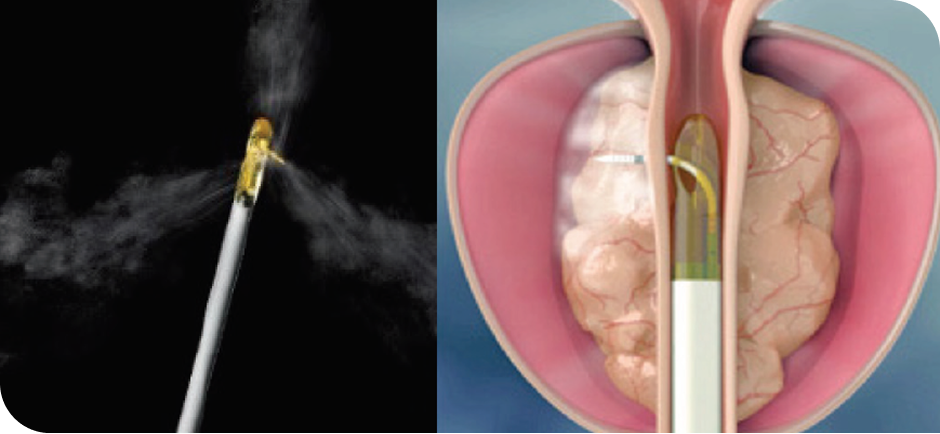
- Water vapor therapy (Rezum): for small but obstructive prostates, in patients who wish to preserve ejaculation.
-
- Transurethral Resection of the Prostate (TURP): the standard procedure for medium-sized prostates.
- Laser enucleation (HoLEP): a modern, minimally invasive, high-precision alternative, with a lower risk of bleeding and earlier catheter removal.
-
- Laparoscopic or Robotic Prostatectomy: currently exceptional, reserved for very large prostates.